
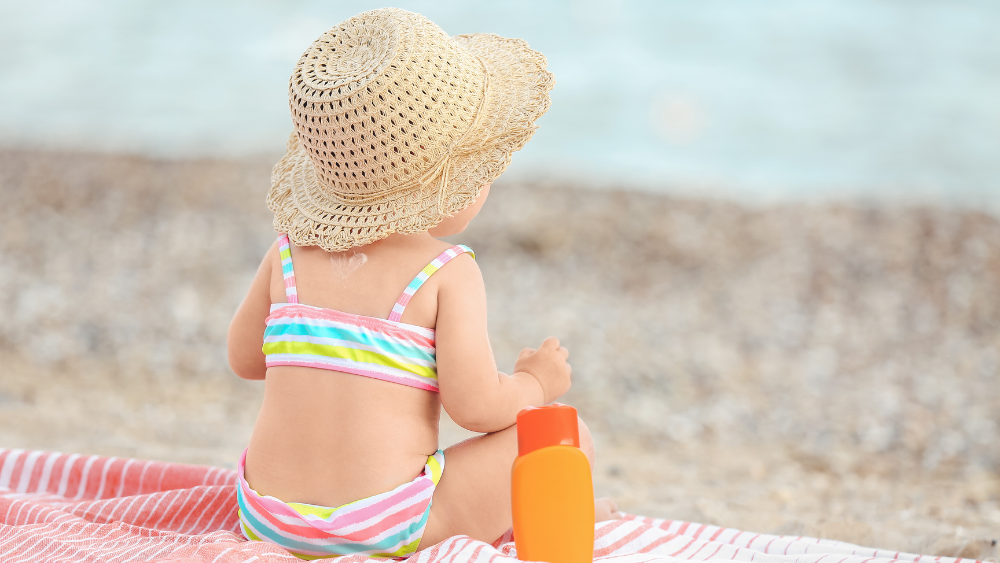
Sunny days are one of the best parts of summer — but too much sun can be harmful. Overexposure increases the risk of serious skin damage and skin cancer, and even a few bad sunburns early in life can significantly raise that risk.
The good news is that simple sun protection habits can make a big difference. Because babies and young children are especially sensitive to the sun, taking extra care is essential before heading outdoors.
Babies under 6 months: skip regular sunscreen
For very young babies, the safest approach is to avoid direct sun exposure. Keep your little one in the shade whenever possible and dress them in lightweight clothing that covers arms and legs. A wide-brim hat (about 3 inches) helps protect the face, ears, and neck.
Look for tightly woven fabrics or clothing with a UPF rating of 30 or higher. If full shade and coverage aren’t possible, a small amount of mineral sunscreen can be used on limited exposed areas like the face.
Choose the right sun hat
A good sun hat is one of the easiest ways to add protection. Wide brims and neck flaps offer the best coverage. Darker, tightly woven fabrics generally provide better shielding.
When buying hats for babies or toddlers, avoid fixed chin cords. If a strap is included, it should have a breakaway safety clasp. Always measure your child’s head to ensure a comfortable, secure fit.
Consider mineral sunscreens
There are two main sunscreen types:
-
Mineral sunscreens sit on the skin and reflect UV rays.
-
Chemical sunscreens absorb UV rays and convert them to heat.
Many parents prefer mineral options with zinc oxide or titanium dioxide, especially for young children. Whichever you choose, look for a broad-spectrum, fragrance-free formula with at least SPF 30.
Check the expiry date
Sunscreen loses effectiveness over time. If the product is expired — or older than three years and the date is unclear — it’s best to replace it.
Lotions and sticks over sprays
While spray sunscreens are convenient, they can be inhaled and often get applied too lightly. Lotions work well for the body, while stick sunscreens are useful for the face, nose, ears, and around the eyes.
If you do use a spray, apply it to your hands first and then spread it onto your child’s skin.
Patch test new products
Before using a sunscreen for the first time, apply a small amount to the inside of your child’s wrist. Wait to see if any redness or irritation develops before full application.
Apply enough sunscreen
For full body coverage, children typically need about one ounce (roughly a shot glass). The face alone needs about half a teaspoon. It’s easy to under-apply, so be generous.
Reapply regularly
Apply sunscreen about 30 minutes before going outdoors. Reapply every two hours — and always after swimming or towel drying.
Use sunscreen as part of a full sun strategy
Sunscreen works best alongside other protective steps:
-
Seek shade whenever possible
-
Limit direct sun exposure during peak hours (10am–2pm)
-
Use wide-brim hats and UV-protective sunglasses
-
Dress children in protective clothing
-
Use a proper stroller canopy or mesh sun shield for airflow and coverage
With a little planning, your family can enjoy sunny days safely and comfortably all season long. 🌞